EFFORT
Do the work others will not do and stay engaged after the excitement fades.
MY STORY
I didn't learn global growth from the sidelines. I learned it by building businesses, losing businesses, opening markets, fixing markets, leading people and being accountable when the plan met reality.
The wins shaped my résumé. The mistakes shaped how I lead. Together they became the experience behind Global Without Guessing and the work I do today with CEOs, boards and executive teams.

THE THROUGH-LINE
“The titles changed. The countries changed. The lesson didn't: strategy only becomes valuable when people can execute it.”
My career has moved through technology, entrepreneurship, direct selling, corporate leadership, international expansion and advisory work. What connects every chapter is the same obsession: how do you turn opportunity into an operating business that works after the launch excitement is gone?
01 · TECHNOLOGY & AUSTRALIA
I began my career in technology, working with two of the largest computer companies in the world at the time. Those roles took me to live and work in Australia.
From a distance, Australia felt familiar. Up close, business culture, expectations and execution were different. I didn't know it then, but that experience taught me one of the ideas that would follow me for the rest of my career: a market can look familiar and still require you to rethink how you operate.
I later built technology businesses of my own. Then the dot-com collapse arrived, and businesses I had built disappeared with it. What looked like a setback became the doorway into an entirely different career.
Global experience started for me with a simple realization: you cannot manage another market as if it were merely an extension of home.
02 · STARTING AT THE BOTTOM
I entered direct selling because I needed income while I figured out what came next. I started exactly where every field leader starts: with no title, no corporate authority and no organization already waiting for me.
Within roughly eighteen months I became the company's top U.S. recruiter, a position I held for three consecutive years. Our organization expanded internationally into markets including Singapore, Thailand, Malaysia and Australia.
That experience changed the way I would later lead as an executive. I learned what corporate decisions feel like at the other end of the organization—when a late commission, an out-of-stock product or a bad promotion is not an abstract operating issue but a leader's personal credibility with his or her team.
People don't experience a company through an org chart. They experience it through the promises the company keeps—or fails to keep.
03 · FIELD TO CORPORATE
As our international field business grew, I was asked to help open offices and support expansion in Southeast Asia. That moved me from independent field leadership into consulting and eventually into full-time corporate executive roles.
The transition was invaluable. Field leaders often underestimate what sits behind a corporate decision: regulation, finance, inventory, technology, taxes, logistics and risk. Corporate teams can underestimate what the field knows about customers, trust, timing and what will actually duplicate.
Having lived on both sides became one of my strongest operating advantages. I could translate the field to corporate and corporate to the field—and challenge both when the answer on paper did not match the reality in the market.
The best international executives understand both the economics of the company and the human system that produces the revenue.
04 · HYPER-GROWTH
As vice president of international for a young wellness company, I helped scale annual revenue from roughly $18 million to more than $400 million in about three years.
In another international leadership role, I led a turnaround across Thailand, Taiwan and Japan that increased revenue by more than 400 percent. Later, as general manager for Greater China at a multibillion-dollar global company, I was responsible for a regional business exceeding $500 million across Hong Kong, Taiwan and mainland China.
I was also part of three companies that grew beyond the billion-dollar mark. Those are the numbers that fit easily into a biography. What they do not show is the operating pressure underneath them: systems, people, inventory, incentives, local leadership and infrastructure all have to mature fast enough to carry the growth.
Growth does not hide weak infrastructure. It puts a spotlight on it.
05 · GREATER CHINA
Greater China sharpened my understanding of localization more than almost any other chapter of my career. Hong Kong, Taiwan and mainland China are connected, but treating them as one market is a mistake.
Language, regulations, product rules, digital platforms, leadership expectations and business culture all change across the region. The challenge is to share what should be shared while protecting the local ownership and local decisions each market requires.
It also reinforced something I now say frequently: you don't enter countries; you enter networks. Regulators, local leaders, partners, suppliers, logistics providers and customers all determine whether the strategy can actually operate on the ground.
The best global standard is not identical execution everywhere. It is clear principles with enough local authority to make them work.
06 · THE SCAR TISSUE
I have watched launches I was proud of become quiet markets months later. I have inherited markets that were opened the wrong way and spent years repairing them. I have trusted the wrong partner, hired the wrong leader and defended plans that should have been challenged sooner.
Those experiences are not the part of a career people normally put on a résumé. They are, however, the reason experience matters.
I sometimes call it a multi-million-dollar education. Every major lesson was paid for somewhere—by a company, a market, a team or a decision that could have been better. That scar tissue is what taught me to ask harder questions before the money moves.
Experience is not the absence of mistakes. It is the ability to recognize patterns early enough to keep the next company from paying the same tuition.
SELECTED CAREER CHAPTERS
Early technology roles, international work in Australia and companies built during the first Internet era created the foundation.
Top U.S. recruiting performance and international team development taught how strategies are experienced by the people expected to execute them.
International sales, marketing and operating roles with accountability for market entry, leadership, systems and scale.
Rebuilding underperforming markets reinforced the value of early signals, local leadership and evidence over enthusiasm.
Regional responsibility across Hong Kong, Taiwan and mainland China deepened the playbook for localization, compliance and cross-border execution.
Through Xpand Global, executive advisory, speaking and Global Without Guessing, I help leadership teams make stronger decisions before commitment becomes expensive.
HOW I TRY TO LEAD
Four words have become a simple leadership standard for me.
Do the work others will not do and stay engaged after the excitement fades.
Bring energy to the mission and make people feel why the work matters.
Tell the truth early, especially when the truth makes the decision harder.
Success should leave people stronger, not simply numbers larger.
Empowered People Inspire Change.
WHY I WROTE THE BOOK
At some point in a career, the question changes from “What can I build next?” to “What have I learned that is worth passing on?”
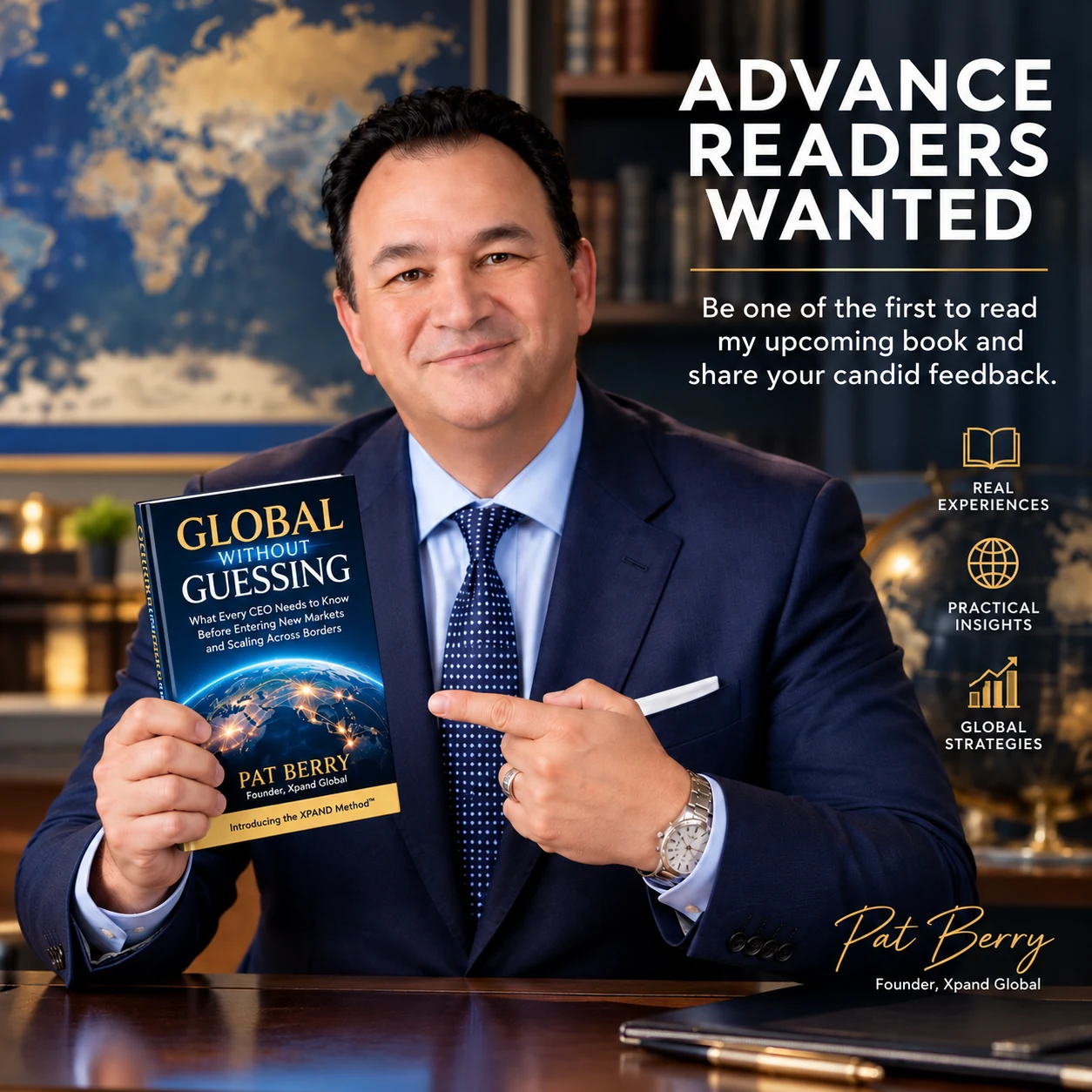
Global Without Guessing is my attempt to put the frameworks, warning signs, questions and lessons in one place. Not theory. Not a highlight reel. The book includes the wins, the wrong turns and the patterns I wish more executive teams recognized before approving another market.
THE WORK TODAY
Today I work with CEOs, boards and executive teams through Xpand Global and selected operating roles—helping companies evaluate markets, pressure-test plans, build local capability and execute across borders.